
What Is 3D Modeling for E-Commerce? Core Concepts and Getting Started
Ertuğrul Çetrefli
31 Jan 2026
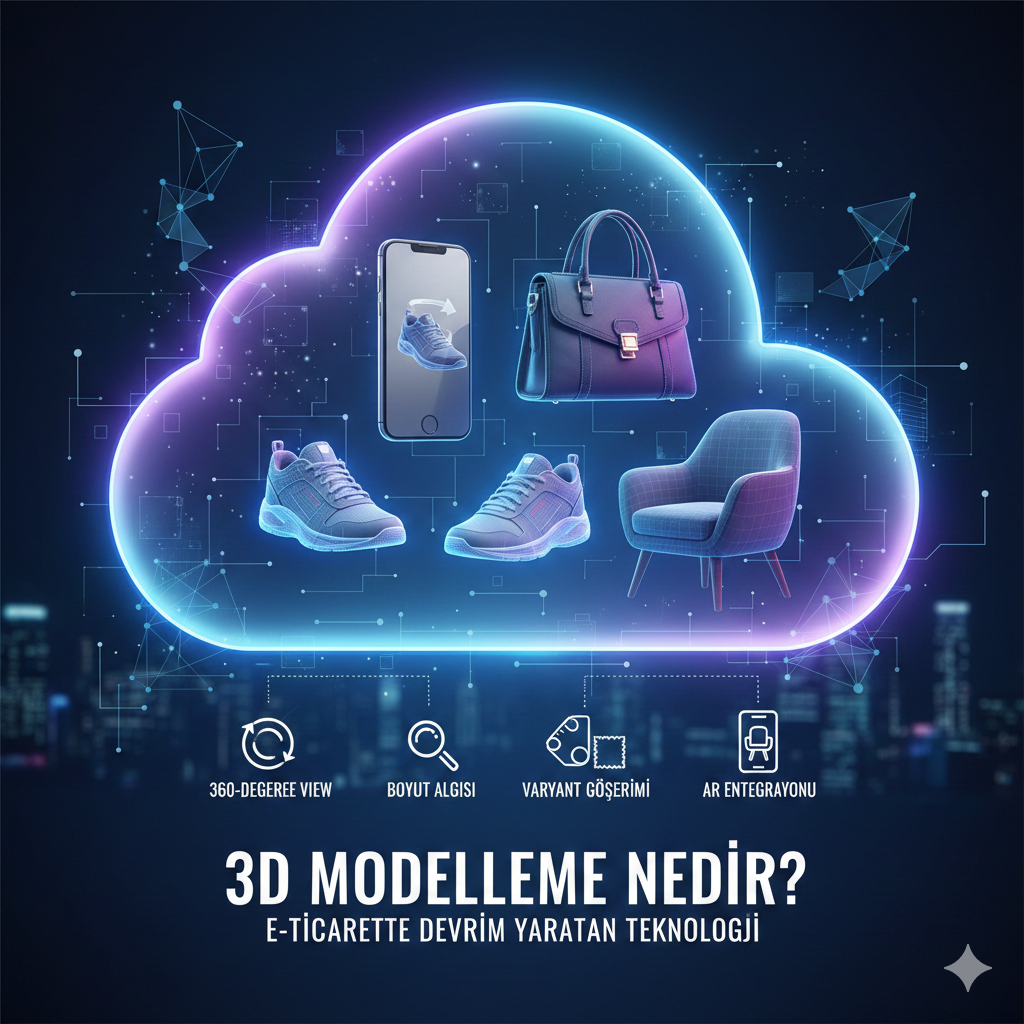
What Is 3D Modeling?
3D modeling is the process of creating a three-dimensional digital representation of a physical object. In an e-commerce context, this means preparing virtual copies of your products that can be examined from every angle in a digital environment.
Traditional product photography captures a limited number of angles, while a single 3D model covers all perspectives. Customers can rotate the product, zoom in, and inspect details on their own terms.
Key Terms
Concepts you will encounter when entering the world of 3D modeling:
- Mesh: The skeleton of a 3D model made up of vertices, edges, and faces. A simple cube has 8 vertices, 12 edges, and 6 faces.
- Polygon: The smallest surface unit forming the mesh. Usually triangles or quads. Higher polygon counts produce more detailed models.
- Texture: 2D images wrapped around the 3D model surface. The wood grain on a table or the weave of a fabric is defined by textures.
- Material: Defines how the surface interacts with light. Metallic shine, glass transparency, or fabric matte are all material properties.
- UV Mapping: The coordinate system that determines how a 2D texture wraps onto a 3D surface.
What Does 3D Modeling Do for E-Commerce?
The biggest drawback of online shopping is the inability to physically examine a product. 3D visualization bridges this gap:
- Product Discovery: Customers can rotate the product 360 degrees to see every detail. The interior compartments of a bag, the sole of a shoe, or the back of a furniture piece are no longer hidden.
- Size Perception: 3D models carry real-world dimensions. Customers get a better sense of actual size, reducing expectation mismatches.
- Variant Display: Different color and material options can be shown on a single 3D model without separate photo shoots for each variant.
- AR Integration: 3D models form the foundation for augmented reality experiences, letting customers virtually place products in their own spaces.
Methods for Creating 3D Models
Manual Modeling
Created from scratch by designers in software like Blender, 3ds Max, or Maya. Offers the highest control but requires expertise and time.
Photogrammetry
Dozens of photos are taken from different angles, and software automatically generates a 3D model. Produces realistic results.
3D Scanning
Physical products are digitized using LiDAR or structured light scanners. Provides high accuracy, especially suitable for complex geometries.
AI-Assisted Generation
Recent AI tools can create 3D models from a single photo or text description. Still evolving but advancing rapidly.
3D File Formats for the Web
- GLB: Binary format containing model and textures in a single file. The most optimized format for web use.
- GLTF: JSON-based, editable format. Same structure as GLB but with separate files.
- USDZ: Required format for AR experiences on Apple devices.
Conclusion
3D modeling is a technology that fundamentally changes product presentation for e-commerce businesses. With the right implementation, you can improve customer experience and boost sales performance.
Stay updated with new articles
Get weekly updates about 3D modeling, web technologies and more.
No spam. Unsubscribe anytime.
Ertuğrul Çetrefli
3DCloud ekibinden. 3D modelleme ve web teknolojileri konusunda icerikler uretiyorum.


